
Certificate in Directing & Writing for Screen
Course Overview
Learn to Write, Direct and Pitch for Film and Television.
This practical course is for aspiring screenwriters and directors who want to build or sharpen their screen storytelling skills. Whether you're starting out or filling gaps in your knowledge, you'll get a clear grounding in how stories are written, developed and made for screen, taught by working industry practitioners.
Why Study a Certificate in Directing & Writing for Screen at Griffith College?
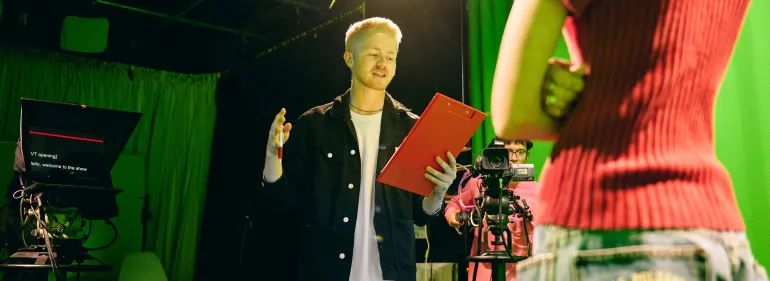
The course combines writing and directing, so you see both sides of how a production comes together. You'll cover narrative structure, character development and scriptwriting, then move into directing techniques used in film and TV: camera movement, staging, performance, pacing, sound and tone.
You'll also produce industry-standard materials, including lookbooks and pitch documents, so you leave able to pitch your own creative work with confidence. As a standalone award, it suits anyone looking to build new skills, refresh existing ones, or prepare for further study in the screen industries.
- Learn screenwriting and directing from experienced industry professionals with real-world film and television production expertise.
- Build a strong foundation in screen storytelling: generate ideas, develop characters, and structure scripts for a range of screen formats.
- Study how directors turn a script into a visual story, covering camera movement, staging, pacing, sound, tone and performance.
- Develop practical directing skills by analysing and recreating techniques from professional film and television opening sequences.
- Create industry-standard pitch materials, including lookbooks and visual treatments, to present your creative vision with confidence.
- Strengthen existing skills or fill gaps in your knowledge on a structured programme that combines creative development with professional practice.
- Gain hands-on experience in both writing and directing, covering the full process from story concept to finished screen production.
- Leave with a portfolio of creative work, ready for further study or a career in the screen industries.
Course Highlights:
- Study with established industry professionals who bring current screenwriting, directing and production experience directly into the classroom.
- Develop both writing and directing skills within a single programme, helping you understand how stories evolve from script to screen.
- Learn through practical, project-based activities that mirror professional creative development and production processes.
- Analyse and apply techniques used in successful film and television productions to strengthen your own creative practice.
- Build confidence in presenting and pitching creative ideas through the development of professional lookbooks, treatments and visual pitch materials.
- Ideal for learners seeking to begin a career in screen storytelling, expand their creative skillset, or address specific gaps in their writing or directing knowledge.
Intake Dates
- Dublin - Blended - October 2026
Course Details
Modules:
Screenwriting 1 (5 ECTS)
This module blends theoretical insights with practical, workshop-based exercises to introduce learners to the fundamental craft of screenwriting and support their development as emerging screenwriters. It guides learners from the core principles of storytelling to the practical skills of script formatting.
Visual Storytelling and Direction for Screen (10 ECTS)
In this module, learners demonstrate detailed knowledge of the key technical and creative skills required to direct short documentaries and drama for screen. The module is delivered through two parallel classes: a) a directing class, focused on creative, technical, and narrative skills for directing documentary and drama and b) a producing/Realisation class, focused on planning, coordinating, and managing production workflows to bring projects from concept to completion. Learners work independently and collaboratively to conceive, develop, produce, direct, and finalise short non‑fiction and fiction projects.
Screenwriting 2 (5 ECTS)
This module supports learners who wish to deepen their understanding and practice of screenwriting. The focus shifts from "what makes a story" to "how do I tell my story with greater sophistication and control?". The module is structured around a rigorous writing schedule, with the primary aim of having each learner complete two polished drafts: a 5-minute script and a 10-minute script, both of which may include dialogue. A key objective is the development of complex characters. Learners will explore techniques for writing authentic dialogue that reveals character and advances plot, and will learn to harness subtext—the unspoken thoughts and feelings beneath the words.
Advanced Screenwriting (5 ECTS)
Having engaged with two earlier screenwriting modules, learners may now build on these core screenwriting skills to craft more complex narratives and to master the industry materials required to support them. Learners are required to write loglines, synopses, treatments, writer’s notes and two drafts of a short drama of maximum 15 pages in length. Scripts written in this module may be produced in the Dissertation by Practice module. Submissions for this module are designed to mirror the industry-standard deliverables frequently required by, for example, funding applications.
Directing and Developing Long Form Content Feature or TV Series (5 ECTS)
This module looks at differences between short-form and long-form development and guides learners through a range of storytelling and directing techniques. Learners will critically analyse the differences between short-form and long-form screen storytelling, including narrative structure, world building, character development, and the demands of extended formats such as feature films and television series. They will also formulate and develop an original long-form screen idea by expanding a first concept into a coherent premise, thematic direction, story world and character framework suitable for feature or episodic production.
For further information, please contact professionalacademy@griffith.ie
Timetables
Timetable
This programme will be delivered two evenings a week from 18:30 - 21:30.
There will be one Saturday workshop from 10:00 - 16:00 every two months.
For further information, please contact professionalacademy@griffith.ie
How to Apply
Entry Requirements
The programme is intended for applicants who have completed their secondary education. Candidates applying on the basis of their Leaving Certificate must obtain a minimum of two H5 grades and four 4 O6/H7 grades, to include Maths and a language (English, Irish or another language).
English Language
The English language entry requirements for the programme are CEF B2+ or equivalent. Candidates with English language levels below CEF B2+ must first reach this minimum standard before enrolling on the academic programme.
Candidates with equivalent grades from other awards and mature learners (23+) are also considered.
If English is not a first language, proof of English proficiency is required. For more information, please visit here.
Fees
Please note that not all study modes may be offered at all times; for confirmation, refer to the Intake dates on the Overview tab.
Tuition Fees
Study Mode: Part-Time
Dublin: €2990.00
Flexible Payment Options
Students wishing to avail of an instalment plan should contact professionalacademy@griffith.ie
Sponsorship
Is your company paying for your course?
They will need to complete a Griffith College Sponsorship Form(PDF file) and send this to professionalacademy@griffith.ie


