
Higher Diploma in Science in Computing

Course Overview
Prepare for a career in one of the world's fastest growing industries with this conversion course.
This exciting Higher Diploma takes students from all disciplines and converts them into ideal candidates for a career in IT. Each graduate will be fully equipped with core computing competencies that will give them the opportunity to pursue an IT career or earn a computing master's.
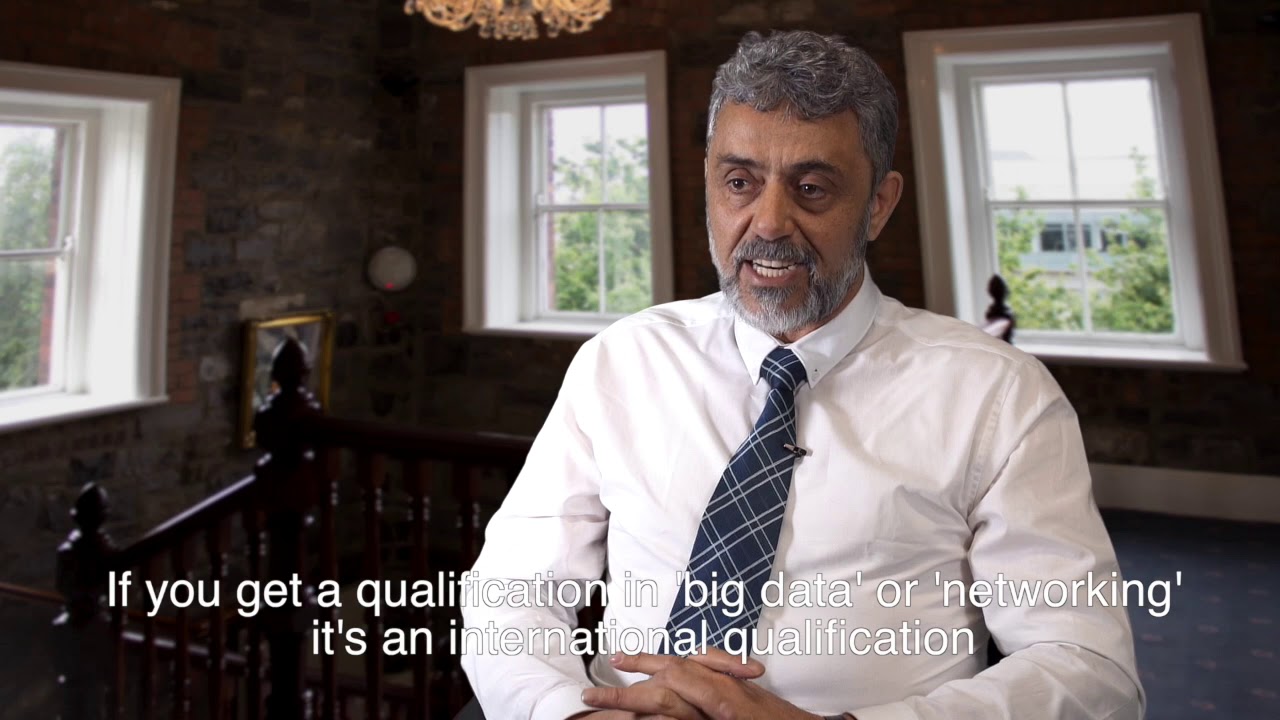
Why Study Computing at Griffith College?
Designed specifically with the needs of industry in mind, the Higher Diploma in Science in Computing Science at Griffith College is a 1-2 year conversion programme, which aims to bridge the gap between non-computing disciplines and computing science. Delivered on a full and part-time basis, as a graduate of this course, you will:
- Fantastic job prospects in a high-demand industry.
- Master core computing competencies which are essential for a career in IT.
- Obtain the necessary skills and academic requirements to further progress into any computer science-based postgraduate study.
- Move into IT from any discipline.
Course Highlights
- Small class sizes
- Access to state of the art facilities
- A dedicated experienced lecturing Team
- Industry guest speakers
- Study in-class or remotely
- View lectures online
Intake Dates
- Dublin - Full-Time - September 2026
- Dublin - Part-Time - September 2026
- Dublin - Blended - September 2026
What Our Graduates Say

Taking part in the HDC, what I enjoyed is that the teaching is very good here, I felt the level of detail and attention you get is very nice at Griffith College, the environment is very good. I feel the up-to-date topics that we learned are very good for my prospects going forward
Higher Diploma in Science in Computing
Course Details
Core Subjects
This essential module transforms you into a skilled programmer by teaching you to design high-quality, systematic solutions to complex problems. You'll master fundamental programming concepts and problem-solving techniques through clear, practical examples that build your confidence and expertise step by step.
This foundational module gives you essential insight into how computers actually work under the hood. You'll explore computer architecture to understand how individual components collaborate seamlessly, then dive into operating systems - the critical software that orchestrates communication between components and manages data efficiently, freeing you to focus on solving bigger problems.
This essential module bridges your secondary-level math knowledge with the specialized mathematical concepts vital for success in computing. You'll master key mathematical notations, operations, and problem-solving techniques that form the foundation for advanced computing work, giving you the analytical tools needed to tackle complex technical challenges with confidence.
This comprehensive module equips you with both the theoretical foundation and practical skills to design, build, and integrate modern database systems. You'll master essential techniques like entity-relationship modeling and normalization to create efficient database designs, then bring them to life using SQL and industry-standard systems like MySQL or Oracle. Beyond database creation, you'll learn to seamlessly integrate databases with programming languages like Java, enabling you to develop sophisticated, scalable applications using the professional N-tier architecture model.
This comprehensive module gives you deep expertise in networking and communication technologies that power our connected world. You'll master everything from basic physical signaling to sophisticated network routing, exploring the essential protocols and standards that keep data flowing seamlessly. You'll gain hands-on experience with WAN technologies, wireless networks, and network security - building the complete skill set needed to design, implement, and secure modern network infrastructures.
This advanced module takes you deep into the inner workings of operating systems, revealing the sophisticated concepts and algorithms that manage computer resources behind the scenes. You'll explore the fascinating complexity of OS design, master fundamental algorithms, and dive into cutting-edge concepts like concurrency, multiprocessing, and distributed systems. Through practical hands-on experience, you'll gain the expertise to understand and work with the critical software that makes all computing possible.
This advanced programming module builds on your foundational skills by immersing you in the powerful world of object-oriented programming. You'll learn to model real-world systems through objects - whether people, cars, houses, or data structures like stacks and queues - creating software architectures that mirror how we naturally think about the world around us. Throughout the module, you'll develop professional software engineering practices, mastering the design and implementation techniques that lead to robust, maintainable code components.
This essential module develops your professional software engineering skills while diving deep into the data structures that form the backbone of efficient software systems. You'll master fundamental data structures - stacks, queues, sets, bags, and maps - learning not just how to use them, but how to implement them using both linear structures like arrays and linked lists, and non-linear structures like binary search trees. By understanding how to choose and build the right data structure for each problem, you'll create more efficient, elegant software solutions.
This vital module puts people at the center of technology design, teaching you to critically evaluate how human factors shape successful system development. You'll explore the key principles of effective computer interface design, learning to create technology that truly serves its users. Through hands-on programming experience in GUI environments, you'll develop the practical skills to build interfaces that are not only functional but genuinely user-friendly.
This hands-on module teaches you to build professional, standards-compliant web applications that harness the power of dynamic databases. You'll start with core client-side technologies - HTML and CSS - then progress to server-side development using PHP and MySQL. By the end, you'll design and create your own fully functional, database-driven web application, giving you the complete skill set to develop modern, interactive websites that can store, retrieve, and manage real-world data.
Timetables
Below is a sample timetable from 2024 to provide an idea of how the semester looks, before the timetable for 25/26 is released.
Full-Time Indicative Timetable.
How to Apply
Entry Requirements
Postgraduate Entry Requirements
Candidates applying for this conversion course should have a Level 8 Honours degree or above in any discipline or international equivalent and/or relevant work experience.
Applicants must apply to Griffith College directly online using the Apply Online facility on the website homepage.
English Language
If English is not your native language, you must show that your English level is of a suitable standard. For further information please contact a member of the Admissions Team.
Griffith College is accepting the online Duolingo English Test (DET) as valid proof of English proficiency. For more information, please visit here.
Fees
For purposes of fee calculation, residence is counted from the time of application.
Please note that not all study modes may be offered at all times. For confirmation, refer to the intake dates in the Overview tab.
Tuition Fees
Study Mode: Full-Time
Dublin: EUR 7,550.00
Study Mode: Part-Time
Dublin: EUR 7,150.00
Study Mode: Full-Time
Please refer to the Irish/EU Living Abroad Fees.
Study Mode: Full-Time
Please refer to our Non-EU Tuition Fees section.
Non-EU students: a Student Services and Administration fee of EUR200 is payable each academic year in addition to the fees quoted.
An Academic Administration Fee of €250 is payable each September at the start of term. For students starting in the January/February term, €125 is payable in February, and then €250 will be payable each September from then onwards.
A 2% Learner Protection Charge is applicable each academic year in addition to the fees quoted. The fees above relate to Year 1 fees only.
Flexible payment options
Students wishing to pay their fees monthly may avail of our direct debit scheme. Please view our Fees information page for more information and assistance.
Sponsorship
Is your company paying for your course?
They will need to complete a Griffith College Sponsorship Form and send this to the Student Fees Office:
- Post: Student Fees, Griffith College Dublin, South Circular Road, Dublin 8
- Email: studentfees@griffith.ie
2% Learner Protection Charge
All QQI accredited programmes of education and training of 3 months or longer duration are covered by arrangements under section 65 (4) of the Qualifications and Quality Assurance (Education and Training) Act 2012 whereby, in the event of the provider ceasing to provide the programme for any reason, enrolled learners may transfer to a similar programme at another provider, or, in the event that this is not practicable, the fees most recently paid will be refunded.
QQI Award Fee
Please note that a QQI Award Fee applies in the final year of all QQI courses. To find the relevant fee for your course level, please see the Fees page.


